Small moments in an empty world
A full map isn't the same as a living one. By now the wasteland was populated — but populated with scenery you walk past. This entry is about the opposite: the few objects in the game that walk back. The ones that react, move, or make the character say something. In a quiet game, these small moments are doing almost all the emotional work.
The red balloon
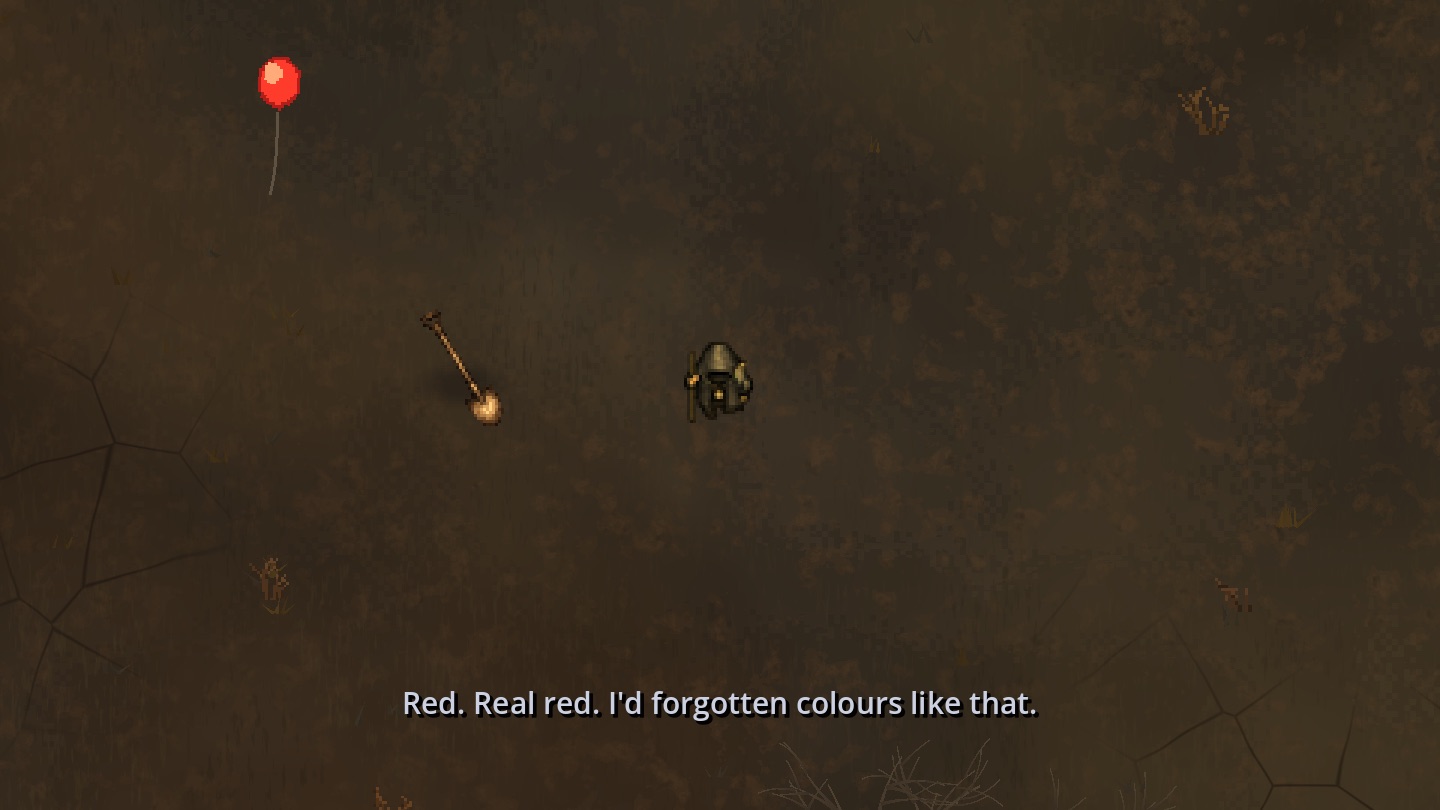
In a world where the strongest art rule is "nothing is green" and nothing is bright, there's exactly one spot of real colour: a child's red balloon, tied on a string, alone in the dead centre of the emptiest part of the map. It sways on the wind and tilts on its tension. When you first see it from a distance, the character says something — and it's the only thing out here that makes you ask "wait, why is that here?"
Then you reach it, and it doesn't stay. The balloon slips loose, rises, grows as it floats toward the camera and then thins away on the wind; the string snaps in the middle, the top whisks off with it and the lower piece settles back to the stake. It's a few seconds of animation for one object you can trigger exactly once — wildly disproportionate effort for the runtime — and it's worth every minute, because it's the single image people will remember.
A motel sign that almost works
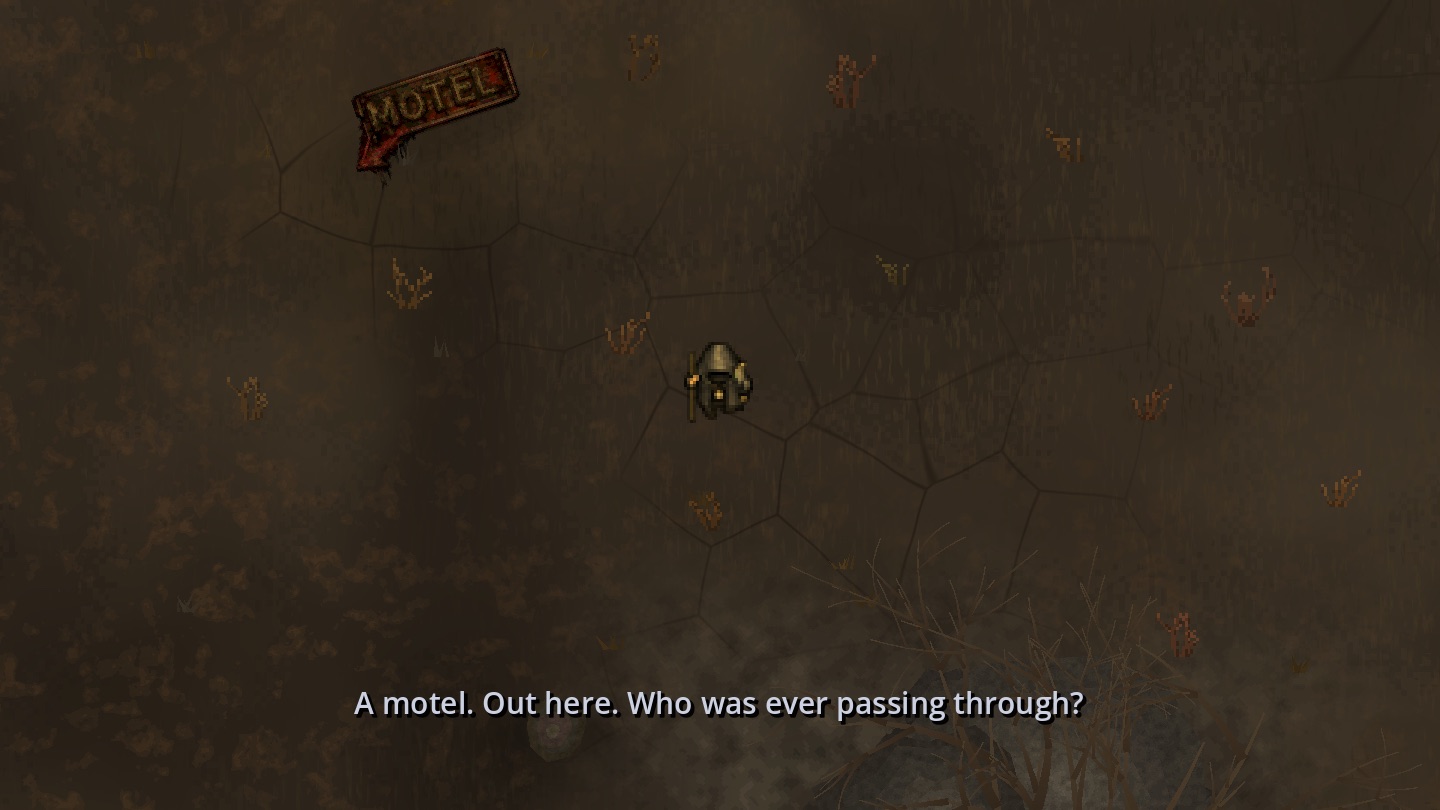
The fallen MOTEL sign is built from a single AI-generated reference, hand-reduced into a few pixel-art layers: letters-off, letters-lit, and a glow halo. The neon is dead. But the first time you walk up to it, it gives one nervous flicker — a flutter that catches, holds for a beat, drops, grabs again, and dies — and the character reacts with a startled half-question. Come back later and there's no flicker; they just muse at it instead. A light that wasn't there, that you can't be sure you saw: it does more for the mood than a fully working sign ever could.
The tumbleweed
Most of the world holds still, so one thing that moves on its own changes the whole feel. A pixel-art tumbleweed rolls on the wind: it sits between gusts, tears loose when one hits, drifts and slows on friction. The rolling is genuinely "from above" — the twigs are 3D curves that tumble around a depth axis rather than a flat pinwheel — and it bounces off obstacles imperfectly, losing energy and veering sideways. Sometimes it snags on a fence and just trembles there until you walk over and nudge it loose, and it rolls on. A tiny interaction, but it makes the wind feel like a real thing in the world.
A character who thinks out loud
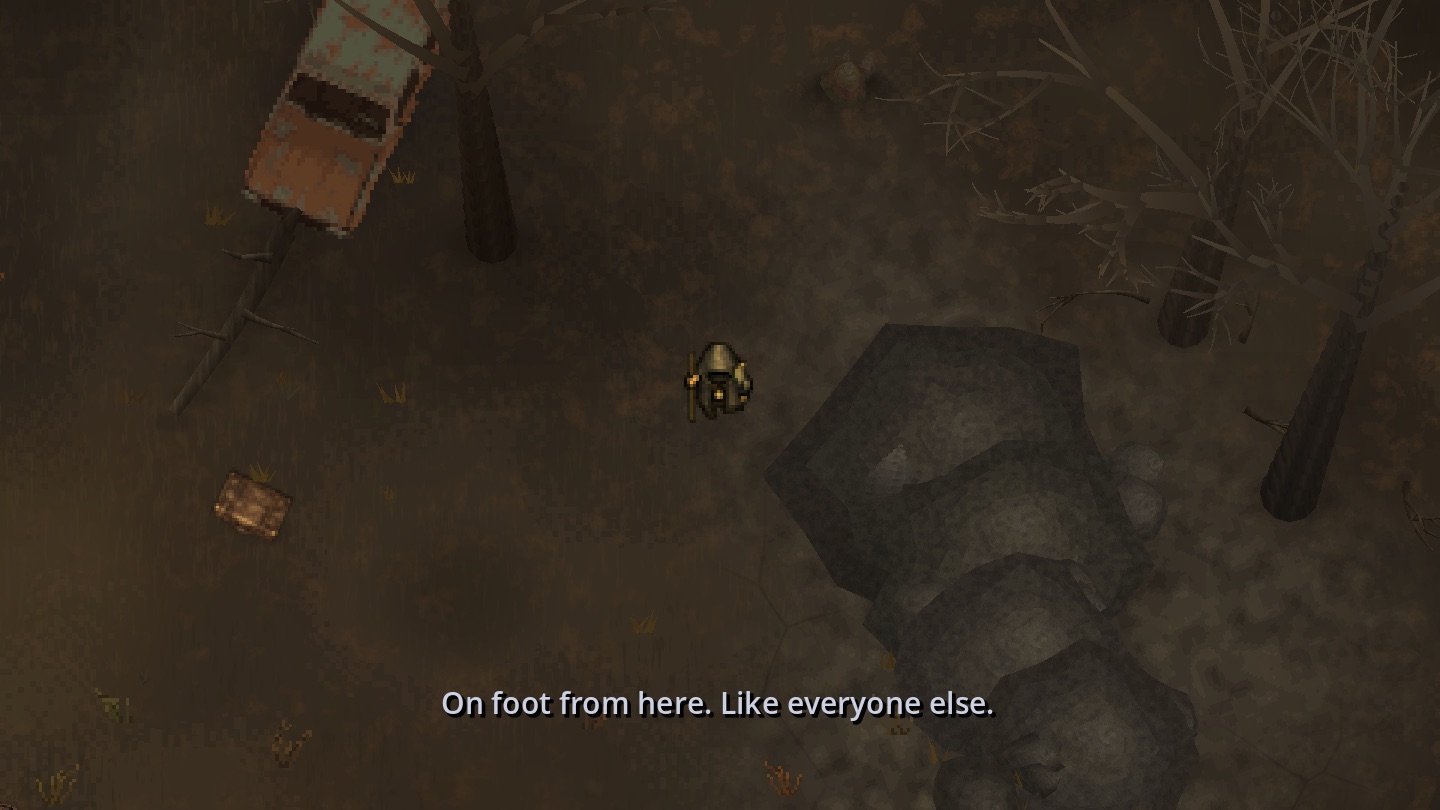
There are no NPCs narrating this place, so the narration is the character muttering to themselves. Two systems feed it. Memory zones are spots along the path that, the first time you cross them, surface a short line — a half-remembered thing, a stray ache about an ordinary life that's gone. And objects have their own lines: walk up to the roadside wreck and you hear something dry and resigned; the wheel torn off it "rolled further than the driver did." Larger objects speak as you approach; small ones only when you're right on top of them, so the comments arrive at the rhythm of actually noticing things.
All of it runs through one queue, so lines never stack or talk over each other — they fade in, hold, fade out, one at a time. The tone is deadpan and tired, with the occasional bleak of dark humour (there's a joke out there with no punchline left in it). It's the closest the game has to a voice.
What's next
The road to a first public version is mapped and deliberately short: an intro told in pixel frames, clearer onboarding so you always know where to go, a couple more encounters on the way, and the dialogue text typing out instead of appearing all at once — the small touch that makes a conversation feel like a conversation. The plan is a complete ~10–15 minute experience, released free, that a stranger can finish and feel something. That first honest reaction is the whole goal of this version.
That's also why this page and devlog exist now, long before there's anything to download: so the work is out in the open, and so by the time there is a build, it isn't arriving to an empty room. If you want to follow along, the game page is the place — more entries will land here as the game gets made.